
Compressed Air Leak Cost in India: What One Leak Costs Your Plant per Month
Compressed air leak cost is the money your plant pays every month to make air that escapes through holes, loose fittings and worn hoses before it does any work. Nobody gets an invoice for leaks; the compressor just runs longer and the power bill quietly rises. A single 3 mm leak at 7 bar can cost around ₹30,000 a month in power. This article shows how much air one leak wastes, how to calculate compressed air leak cost in rupees, and how to measure and cut it.

Why Compressed Air Leak Cost Is Easy to Ignore
Compressed air is one of the most expensive utilities in a factory, because most of the electricity a compressor draws leaves as heat. Leaks make this worse: the air you paid to compress is lost completely.
Leaks are easy to ignore for three reasons:
- They are silent during production. Machine noise hides the hiss, so most leaks are only heard on a Sunday or during a shutdown.
- Air looks free. There is no meter on most air lines, so no department owns the cost.
- The loss is spread out. Fifty small leaks of 1–2 mm each look harmless one by one, but together they can keep an extra compressor running.
Energy studies of industrial air systems commonly find that poorly maintained plants lose 20–30% of compressor output to leaks. Well-run plants keep leakage below 10%.
How Much Air Does One Leak Waste?
The amount of air a leak wastes depends mainly on the size of the hole and the line pressure. The table below uses standard orifice-flow values at about 7 bar(g) (100 psig), the typical working pressure in Indian plants. The cost columns assume a screw compressor that uses 0.12 kWh for every m³ of free air delivered, power at ₹8 per kWh, and a line kept pressurised 24 hours a day (720 hours a month).
| Hole diameter | Air lost (CFM) | Air lost (m³/h) | Power wasted (kW) | Cost per month (₹) | Cost per year (₹) |
|---|---|---|---|---|---|
| 0.8 mm (1/32″) | 1.6 | 2.8 | 0.3 | 1,900 | 22,800 |
| 1.6 mm (1/16″) | 6.5 | 11 | 1.3 | 7,600 | 91,500 |
| 3.2 mm (1/8″) | 26 | 44 | 5.3 | 30,500 | 3,66,400 |
| 6.4 mm (1/4″) | 104 | 177 | 21.2 | 1,22,100 | 14,65,600 |
Two things stand out. First, leak flow rises with the square of the hole diameter, so doubling the hole size multiplies the loss by four. Second, real leaks through cracks and loose threads are usually a little smaller than these rounded-hole figures, so treat the table as an upper estimate. If you are not sure what CFM means or how it converts to m³/h, our guide to the CFM full form and how to calculate CFM explains it.
How to Calculate Compressed Air Leak Cost
You need four numbers: the leak flow, your compressor’s specific power, the hours the line stays pressurised, and your power tariff.
Leak cost per month (₹) = Leak flow (m³/h) × Specific power (kWh/m³) × Hours per month × Tariff (₹/kWh)
- Leak flow: from the table above, from a leak detector estimate, or from a flow sensor reading when production is stopped.
- Specific power: a well-loaded screw compressor at 7 bar typically uses 0.10–0.13 kWh per m³ of free air. Older or part-loaded machines use more.
- Hours: use 720 hours a month if the air main stays pressurised round the clock, because leaks do not stop when a shift ends.
- Tariff: your actual industrial rate per kWh including demand and fixed charges spread per unit.
To skip the arithmetic, enter your own pressure, hole size, hours and tariff in the compressed air leak cost calculator. It gives the monthly and yearly cost of each leak in rupees.
Worked Example: Leak Cost for a 75 kW Compressor Plant
Take an auto-components plant with one 75 kW screw compressor running at 7 bar. On a Sunday, with all machines switched off and the air main still pressurised, the team times the compressor’s load/unload cycle.
- Loaded time (T): 15 seconds
- Unloaded time (t): 45 seconds
Leakage % = T × 100 ÷ (T + t) = 15 × 100 ÷ 60 = 25%
So a quarter of the compressor’s output is feeding leaks. As a simple estimate, the leaks account for 25% of the 75 kW loaded power:
- Power lost to leaks = 75 × 0.25 = 18.75 kW
- Monthly cost = 18.75 kW × 720 h × ₹8 = ₹1,08,000 per month
- Yearly cost = ₹1,08,000 × 12 = ₹12,96,000 per year
If the plant finds and fixes leaks to bring leakage down to 10%, it recovers 15% of 75 kW, which is 11.25 kW. That is about ₹64,800 a month or ₹7.8 lakh a year, usually for the cost of fittings, hoses, seals and a few days of maintenance time.
How to Measure Total Leakage in Your Plant
Before you can control compressed air leak cost, you need a baseline. There are three practical ways to get one.
1. Load/unload test. Used in the example above. It works for fixed-speed compressors with clear load and unload cycles. Take readings over several cycles and average them.
2. Pressure decay test. Useful for VFD compressors or when the cycle is hard to time. Switch off the compressor, isolate it with the air main pressurised, and note how long the pressure takes to fall between two values. Then:
Leakage (m³/min of free air) = V × (P1 − P2) ÷ (T × 1.013) × 1.25
where V is the total volume of receiver and piping in m³, P1 and P2 are the start and end pressures in bar, T is the time in minutes, and 1.25 corrects the leak rate back to normal working pressure. For a 3 m³ system that drops from 7.0 to 6.0 bar in 2 minutes, leakage is about 1.85 m³/min (around 65 CFM). At 0.12 kWh/m³ that is 13.3 kW, or roughly ₹76,800 a month.
3. Continuous flow measurement. The two tests above give you one number on one day. A thermal mass flow sensor on the compressor discharge or main header shows actual flow at every hour, so the non-production flow on nights and Sundays becomes your live leak figure. Connected to smart monitoring software, it alerts you when leakage creeps back up.
How to Cut Compressed Air Leak Cost: Find, Fix, Monitor
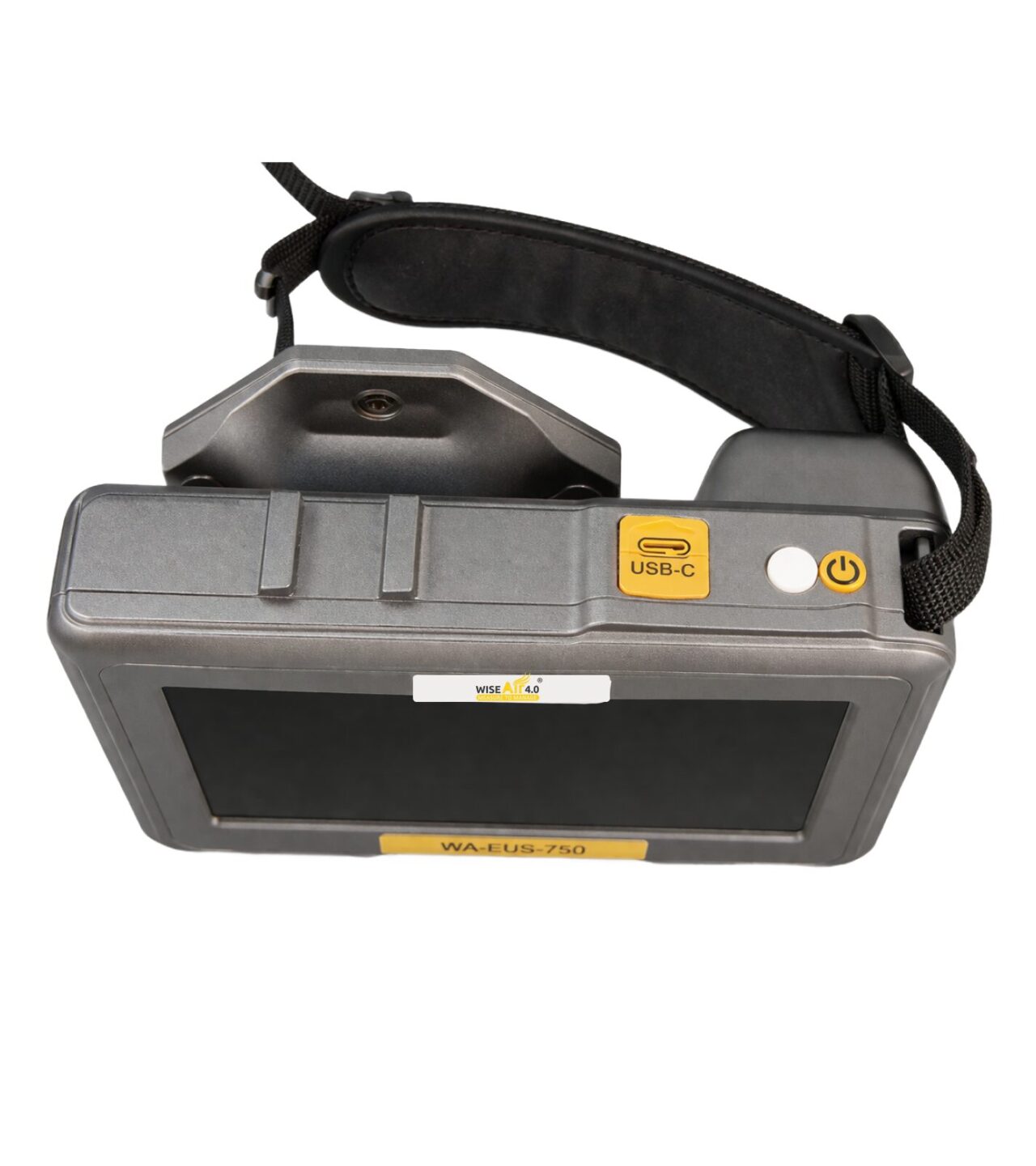
Find. Most leaks are at quick couplers, FRL units, hose joints, drain valves, threaded fittings and cylinder seals. Listening by ear only works during shutdowns. An ultrasonic detector such as the WA-EUS-740 ultrasonic leak detector picks up the high-frequency sound of escaping air even with machines running. For long overhead lines and crowded areas, the WA-EUS-750 acoustic leak imager shows each leak as a hotspot on screen so you can survey a whole bay in minutes. Our compressed air leak detection guide covers the survey method step by step.
Tag and prioritise. Tag every leak with a number, location and estimated size, and fix the largest first.
Fix. Replace damaged hoses and couplers, re-seal threads, repair or replace stuck drains, and close air to idle machines with isolation valves. Also check whether the header pressure can be lowered: leaks waste less air at lower pressure.
Monitor. Leaks come back. Plants that keep leakage low repeat the survey every quarter and track non-production flow every day. Combined with better pressure control and compressor sequencing, a measured leak programme can help a plant save up to 30% on compressed air energy.
Frequently Asked Questions
How much does a compressed air leak cost in India?
At 7 bar, ₹8 per kWh and round-the-clock pressure, a 1.6 mm leak costs about ₹7,600 a month, a 3 mm leak about ₹30,500 a month and a 6 mm leak more than ₹1.2 lakh a month.
What is an acceptable level of compressed air leakage?
Below 10% of compressor output is a good target for most plants. Many unmanaged plants are at 20–30%.
Does lowering pressure reduce leak cost?
Yes. Leak flow falls as line pressure falls, and the compressor also uses less power per m³ at lower pressure. Lower it only as far as your end users allow.
Can I find leaks during production?
Yes. Ultrasonic leak detectors and acoustic imagers work in noisy areas because they listen at frequencies above normal machine noise.
How often should a plant check for leaks?
A full survey every three months is a practical minimum, with daily tracking of non-production air flow in between.
Put a Rupee Value on Your Leaks
Compressed air leak cost is one of the few energy losses you can measure, fix and verify in the same month. Start with a load/unload or pressure decay test, put a rupee figure on it with the leak cost calculator, and then use leak detection and flow monitoring to keep it down. Talk to the WiseAir team about measuring the real leakage in your plant and the tools to find and fix it.
Turn this into numbers for your own system
Reading about it is the easy part. Our free calculators let you put your own pressure, tariff and running hours in and see what the problem is actually costing you.
Prefer to talk? Call +91 90477 78715 or +91 98944 49015. Ready to measure rather than estimate? Book a compressed air audit.