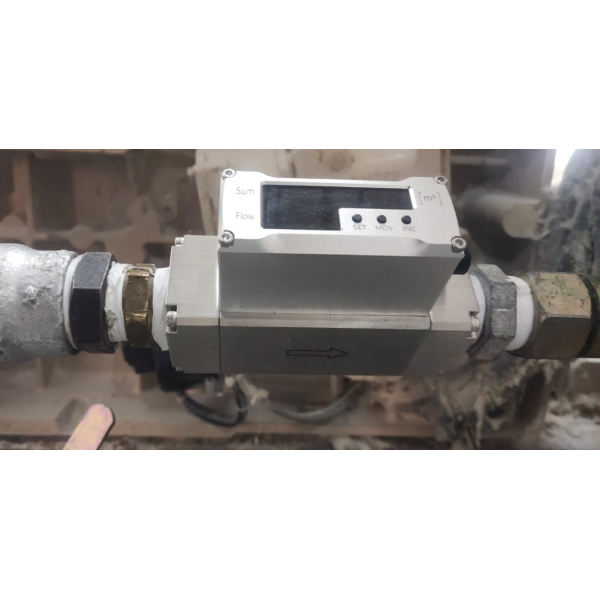
Introducing the WAFS 108 Compact Air Flow Sensor – your economical choice for precise measurement at consumption points. Effortlessly adaptable, the WAFS 108 excels in measuring a wide range of gases, including nitrogen, without needing extra compensations for air pressure or temperature. Experience high-resolution, rapid, and accurate readings tailored to streamline your end-use monitoring.
What Is the WAFS 108 Compact Air Flow Sensor Used For?
The WAFS 108 is a compact flow sensor designed for measuring air consumption at the point where air is actually used. Instead of relying only on readings from the compressor room, it lets maintenance and energy teams see how much air a single machine, workstation or end-use point draws, which makes it easier to spot areas that consume more than expected.
It is an economical choice for plants that want flow data at several points without a large investment at each one. It can measure a wide range of gases, including nitrogen, and it does not need extra compensation for air pressure or temperature. To compare its readings with datasheets or other meters, you can convert compressed air flow units in a few seconds.
How Does the WAFS 108 Measure Flow Accurately?
The WAFS 108 works on the thermal mass flow principle, so the reading is independent of changes in temperature and pressure. Full digital signal processing, used instead of a traditional analog bridge design, helps the sensor deliver high-resolution, rapid and accurate readings over a wide measuring range, with a 1:100 turndown ratio.
A specially designed flow conditioner supports accurate measurement without adding pressure drop, and the sensor has no moving parts, which keeps the signal stable and suits vibration-prone areas. Its complete stainless steel body adds to long-term reliability. If a line suits a flanged or threaded full-bore installation, the inline type thermal mass flow sensor is another option to consider.
Where Does a Compact Flow Sensor Fit in a Compressed Air System?
A compact sensor is useful at the end of the distribution network, where individual machines and production stations draw air. Measuring at these points builds a baseline for normal consumption, so a rise in demand without a matching change in production becomes a clear signal to investigate. This kind of machine-level monitoring is common in textile mills, and you can see it in our guide to compressed air monitoring for textile manufacturers.
The WAFS 108 has a standard RS485 Modbus RTU interface, so its data can be passed to a suitable monitoring or control system. It also includes an in-built pressure sensor alongside the flow measurement, which lets you view pressure and flow at the same point.